What to see at Mont-Saint-Michel, in the order you encounter it
1. Arrival and the footbridge
The shuttle drops you 350 m from the ramparts, and those final 350 metres offer the best view of the day. Don’t walk with your head down. Depending on the tide coefficient, you’ll see sand, salt meadows or, beyond 110, water all around: the mechanism is explained on tides and the bay.
2. The Porte du Roy and the Grande Rue
You enter via the Corps de Garde des Bourgeois and the Porte du Roy, then the Grande Rue climbs, narrow, between shops and crêperies. This is the stretch people hate at midday and love at 8 am, when the shutters are still closed. Free public toilets are 50 m past the drawbridge, open 24 / 24 and accessible for people with reduced mobility. Dogs on leads are allowed in the village but never in the abbey or the parish church.
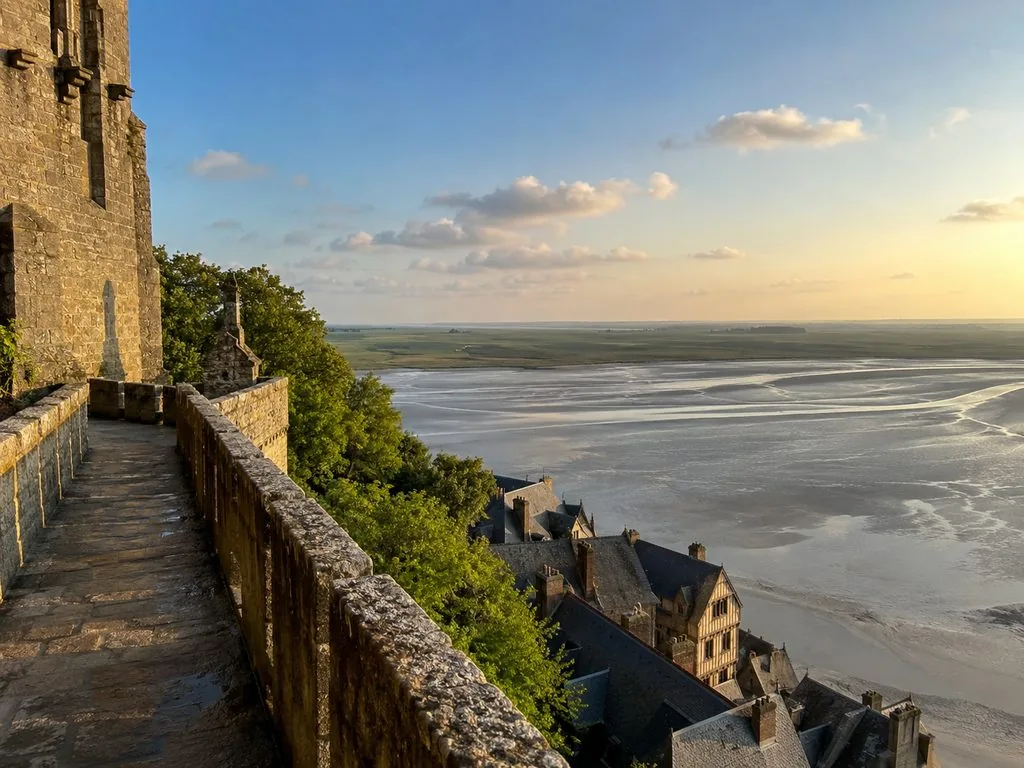
3. The ramparts
Free and often empty while the Grande Rue is jammed, they offer the bay view everyone seeks from the car park. If you have only an hour and no ticket, this is where to spend it.
4. The Grand Degré and the 350 steps
First the Grand Degré, then the internal stairs: roughly 350 steps separate the village entrance from the abbey, with no lift. Alexandra, who came on a guided tour, found the stairs manageable. I agree, with good shoes and no luggage: large bags and suitcases are refused at the abbey; folded pushchairs are allowed. Details are on steps and accessibility.
5. The abbatial church
It stands 80 m above sea level, and the spire topped by the statue of Saint Michael reaches 160 m. Construction began in 1023; the Gothic choir was completed in 1523. This is the high point of the visit and the spot from which the entire bay comes into view.
6. La Merveille
This is the name given to the Gothic buildings constructed in the 13th century: the grand halls and the cloister. Willem, who has bought the ticket, sums up the effect: the alleys, the staircases climbing upwards, the interior—everything is impressive. A useful reminder to place what you’re looking at: the abbey was founded in 708 by Aubert, Bishop of Avranches, after three appearances by the Archangel Michael, and the Benedictines settled there in 966.
7. The prison, and the monks’ return
The abbey served as a prison from 1793 to 1863, was listed as a historic monument in 1874, and a religious community returned in 1969. The Mount and its bay were inscribed on the UNESCO World Heritage List in 1979. These three dates explain the bare look of some rooms: between 1793 and 1863 the place was a prison, not an abbey.
8. The descent
If you can, take the other staircase, pass through the village parish church, and keep twenty minutes for the ramparts if you haven’t done them on the way up. Allow 2 to 3 hours for all of this; how to fit it into the rest of a day is on how long to plan, and the general context on the Mont-Saint-Michel guide.
The reverse order also works and is better in summer: go straight up to the abbey via the Grand Degré without stopping, then descend via the Grande Rue and finish with the ramparts. You’ll pass the coaches on the way down.
See the village with someone who lives there
An hour and a half to two hours in a small group, covering the history and legends of the Mount. Abbey entry is not included.
Frequently asked questions
What to see at Mont-Saint-Michel in half a day?
The Grande Rue, the ramparts and the abbey, in either order depending on crowds. Allow 2 to 3 hours for the abbey and village, plus 45 minutes to 1 hour to walk up from the car park: see how long to plan.
What can you see for free at Mont-Saint-Michel?
The entire village: the Grande Rue, the ramparts, the parish church, the public toilets on the Grande Rue, and access is round the clock, 24 h/24. Only the abbey is chargeable, with seasonal rates.
What is La Merveille?
The Gothic buildings built in the 13th century on the northern flank of the abbey, with their stacked halls and cloister. They are included in the visit covered by the ticket: seeabbey tickets.
Can I visit Mont-Saint-Michel with a dog?
Yes, in the village if kept on a lead. Dogs are not allowed inside the abbey or parish church, except guide dogs. Small dogs under 10 kg may travel in a bag on the shuttle, and a kennel is available at the information centre near the car park.